


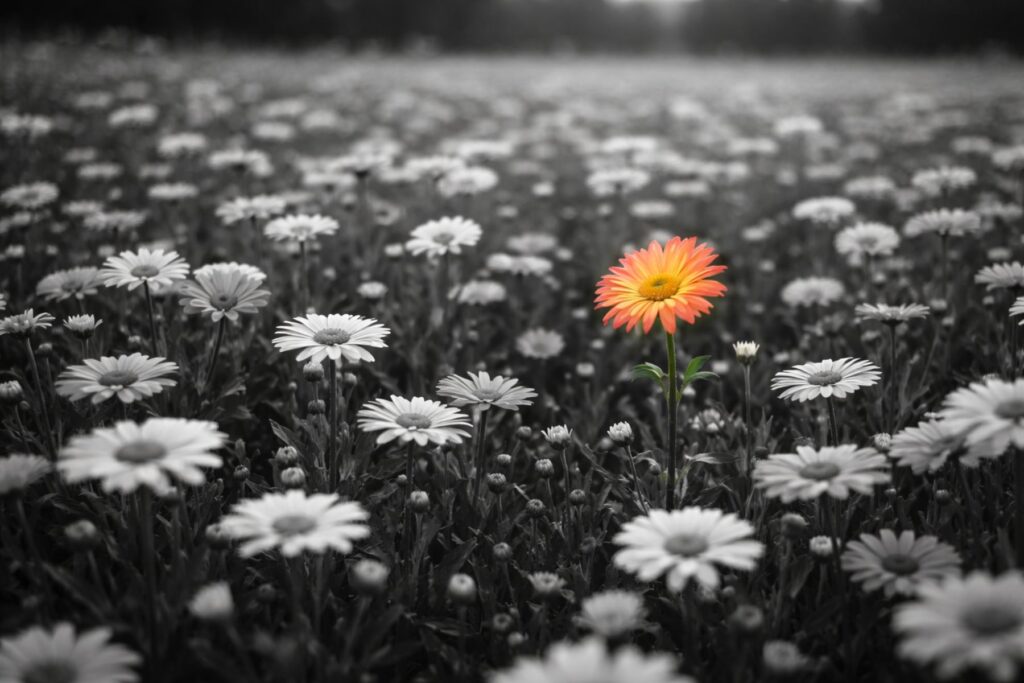
Rev. Koshin Ogui once wrote:
“A flower does not think of competing with the flower next to it. It just blooms.”
I love that quote.
I live that quote.
But it almost feels rebellious — this idea of simply blooming.
And in a world that constantly measures worth, compares progress and ranks growth, I’ve been thinking a lot about what that blooming actually looks like.
I mean, this is a world where so many of us are taught to look sideways before we look inward.
To check who’s ahead of us.
Who’s behind us.
Who’s doing it better — or worse.
We’re taught to treat life like a scoreboard, to measure our pace against someone else’s timeline and to believe growth only counts if it’s visible, validated or praised.
We’re taught that slowing down means falling behind — and standing still means you’re failing.
So we learn to watch instead of listen.
To compare instead of feel.
To ask, “How am I?” when we should be asking, “Who am I?”
But a flower — a flower doesn’t pause to calculate its value.
It never checks the height of the stem beside it.
It never wonders if it’s blooming too early or too late.
It never shrinks itself because another flower is louder, brighter or more vibrant.
It doesn’t delay opening out of fear that it won’t be enough.
And it doesn’t wait for anyone’s permission or approval.
It simply blooms — because blooming is all it knows.
And once it blooms, the world responds.
That response — that’s the part that gets me. Because, while the flower doesn’t think of competing with the flower next to it, that’s not to say it blooms quietly.
That’s not to say it blooms alone.
Because during that bloom, conditions change. People pass by. And those people make a difference — for better or worse.
Some of them see the flower — some of them don’t.
Some of them stop long enough to smell the flower — some of them keep walking.
Some of them reach out and pluck the flower — some of them know better.
But all of those people play a unique role in that flower’s bloom — and its wither.
Because blooming doesn’t just reveal the flower — it reveals the people around it and how those people treat what they didn’t grow themselves.
I’ve seen enough of these people to know which role they play.
I see a lot of the same reactions.
The same hands.
The same feet.
The same neglect.
Different faces — but the same behavior.
I see the person who doesn’t care about the flower.
They don’t stop. They don’t look down. They move through the field like nothing delicate could exist there — like growth is something sturdy enough to withstand their weight.
The flower could bend, it could break, it could be crushed beneath the urgency of that person’s direction — but none of that is of their concern.
So they step on it.
Crush it.
Kill it.
As if it doesn’t exist.
And somewhere behind them, the field is quieter.
Lonelier.
It’s missing something — something they’ll never notice is gone.
And they never once think about what they just stepped on — or the damage they’ve caused.
This type of person is everywhere.
They’re the ones who move through others’ lives the same way — without slowing, without regard, without considering what their urgency costs someone else.
They don’t ask what it took for someone to bloom.
They don’t ask what was lost when they passed through.
And they don’t always mean to destroy — but they certainly don’t notice when they do.
They just keep walking. Unaware of the emptiness they leave behind.
I see the person who plucks the flower.
They look for it. Find it. Obsess over it. They tell the flower it’s beautiful — that they’ve never seen anything like it before. There could be thousands of flowers in that field, but they want that flower.
So they reach for it — gently.
As if gentleness alone makes them harmless.
And they pick it. Choose it. Pluck it.
They pull it from the soil that fed it. From the place that held it upright. From the place that made it bloom.
They take it with them. Display it. Keep it. All for themselves.
And slowly, quietly, the flower begins to wither — not because it wasn’t strong, but because it was never meant to survive in someone else’s bloom.
These people show up in your life as lovers, as friends, as people who say, “I just want you to be mine.”
But they don’t realize that removing someone from what sustains them is a unique kind of harm — even when it’s done gently.
They don’t mean to take the life out of someone.
But they do — just as much as the person who stepped on them.
And they never realize that what they loved most could only survive where it was planted.
I see the person who admires the flower.
They stop. They notice. They see the flower. They take in its color and shape. They appreciate the way it chose to open right where it is. The way it decided to be — just as it was always intended.
Maybe they paint the flower. Write about the flower. Or take a photograph of the flower — and frame it.
But they know better than to reach for it.
They know better than to touch it.
They don’t try to claim it.
They understand that not everything beautiful is meant to be held or kept — or plucked. That some things are simply meant to be. Some things are simply meant to bloom — undisturbed.
So, they let the flower stay rooted.
Whole.
Alive.
And when they leave, the field remains full. The flower is exactly as it was — still standing.
Still blooming.
In life, these people are easy to miss — but hard to forget.
They don’t try to change you. They don’t ask you to bloom differently or faster. They don’t rush your growth or interrupt it. They don’t leave marks — or wounds.
These people don’t take up space in your life — they protect it.
They understand that the best way to help something grow is sometimes to simply let it be.
I see the person who waters the flower.
They know when the soil is dry. They know when the sun is too harsh. And they know when the bloom is tired — when it needs help. When it can’t bloom alone.
They show up consistently — not loudly, not urgently — but faithfully.
They give without taking. They help without controlling. They nurture without reshaping. They understand that growth needs support, not pressure.
They don’t pull the flower toward the light.
They bring the light to the flower.
And they don’t take credit for the bloom because they know better than anyone that it was always capable of becoming.
They just helped create the conditions.
And because of them, the flower doesn’t just survive.
It continues to bloom.
Rooted, resilient and entirely its own.
You need these people in your life.
They’re not just friends — their partners. They’re not just supportive — they’re invested. They’re not just present — they’re deliberate.
Intentional.
They don’t try to be the reason you bloom. They just make sure nothing gets in the way of it.
And when you look back on the seasons where you grew the most, you realize — they were there.
Sometimes when no one else was.
Maybe that’s the point of Rev. Koshin Ogui’s quote.
Not that blooming is easy — not that blooming is safe — but how the flower never changes itself based on who passes by.
Because you will be stepped on.
You will be taken from your roots.
You will be admired, misunderstood, mishandled — all of the above.
But still — you get to choose who you allow close.
You get to choose the conditions you grow in.
You get to bloom anyway.
Not in competition. Not for approval.
You get to bloom because it’s who you are. And it’s who you were meant to be.
So, bloom.
Unapologetically.
Fearlessly.
Openly.
Patiently.
Fully.
As if it’s the only thing you know.

0