


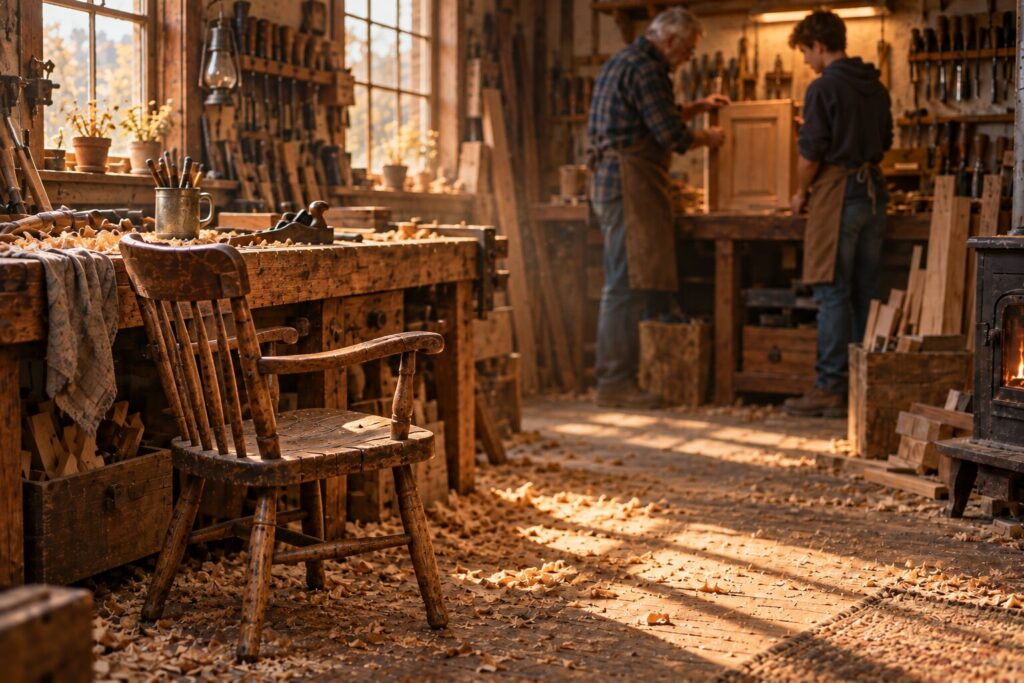
There is a certain order to a workshop. Not necessarily the kind of order that makes sense to anyone walking into it for the first time. To an outsider, it may not look like order at all.
But to the person who works there, almost everything has a place.
A pencil worn nearly to the eraser may sit beside a brand-new one because it still has a few good lines left in it. A piece of wood that looks like scrap to everyone else may be waiting for the right project.
Even the clutter has a kind of logic to it.
That was certainly true of Graham’s workshop.
Graham had been working with wood for most of his life, and his workshop reflected it. His tools were kept where he needed them, their handles worn smooth from years of use.
Small piles of sawdust collected in the same familiar corners. Scraps were stacked against a wall, some new and pale, others darkened with age. Even the quietest corners felt intentional.
It was unmistakably Graham’s space, and Eli loved being in it.
Eli had first seen one of Graham’s tables in a small furniture shop across town. There was nothing flashy about it. No elaborate carving. No unusual shape meant to make someone stop and stare.
It was just a table.
But Eli had stopped and stared anyway.
The joints were nearly invisible. The grain seemed to run exactly where it should. Even the imperfections in the wood looked deliberate, as if Graham had somehow convinced the tree to grow that way.
Eli asked the shop owner who made it.
“Graham,” he said. “Works out of a little shop a few blocks from here.”
Over the next few weeks, Eli found himself thinking about the table more than he expected. Eventually, curiosity won, and he went looking for Graham’s workshop.
When he finally found it, he told himself one visit would be enough. He just wanted to meet the man behind the table.
It wasn’t enough.
Eli came back. Then he came back again.
There was never any formal arrangement between them. Sometimes Graham showed him what he was working on. Sometimes Eli asked too many questions. Other times, they barely spoke at all.
Graham never invited him to learn, but he never told him to stop watching, either.
So Eli watched.
He watched Graham reject pieces Eli thought were perfectly fine and save pieces he would have thrown away. He seemed to notice flaws, possibilities and small details Eli would have missed completely.
But over time, Eli began to notice something else.
An empty chair.
It sat a few feet from Graham’s workbench, close enough that whoever occupied it could watch him work but far enough that it was out of his way.
It was old.
Not antique old. Just used old, with a thin layer of dust settled across the seat.
The finish had faded in places. One of the arms was cracked. The back leaned ever so slightly to one side, and if you looked closely enough, one of the front legs was shorter than the other three.
At first, Eli assumed Graham still used it for something.
Then he noticed that nobody ever sat in it.
Everything else in the workshop had a purpose. Lumber came and went. Tools migrated from drawers to benches and back again. Half-finished pieces slowly became finished ones.
The chair was the one thing that never seemed to change.
One afternoon, Graham was sanding the edge of a cabinet door while Eli stood nearby watching. The steady scrape of sandpaper filled the workshop until Eli finally broke the silence.
“Can I ask you something?”
Graham kept sanding.
“You usually do.”
Eli smiled and nodded toward the chair.
“What’s with the chair?”
The sound of the sandpaper stopped.
It wasn’t dramatic. Graham didn’t freeze or suddenly turn toward Eli. He simply stopped working for a moment, his hand still resting on the edge of the cabinet door.
Then he looked over at the chair.
“That was Lou’s chair.”
Eli could tell from the way Graham said his name that Lou had been important.
“Who was Lou?”
Graham rubbed his thumb along the edge he had been sanding, as if checking for a rough spot that wasn’t there.
“He taught me.”
“Woodworking?”
Graham gave a small shrug.
“Most things.”
Eli looked back at the chair. Now that he knew it belonged to someone, the crack along the arm and the faded finish seemed less like damage and more like evidence.
“Did he build it?”
That finally made Graham smile.
“No.”
“You did?”
“First chair I ever built.”
Eli walked a little closer, studying the chair with the same attention he usually gave Graham’s finished work.
“The leg’s too short.”
“I know.”
“And the back is crooked.”
“I know.”
Eli ran his eyes along the cracked arm.
“What happened here?”
“Drilled too close to the edge. Lou wouldn’t let me fix it.”
Eli laughed, and this time Graham did too.
For a moment, the chair lost some of the heaviness that had entered the room with Lou’s name.
“I hated that thing,” Graham said.
“But you kept it anyway?”
“Lou kept it.”
Graham set the sandpaper down and leaned against the workbench. He wasn’t usually someone who volunteered stories. If Eli wanted to know something, he usually had to get there one question at a time.
This time, Graham kept talking.
“I was 19 when I made it. Maybe 20. Thought I knew what I was doing.” He glanced at the chair. “I finished it, took one look at it and wanted to tear the whole thing apart.”
“Lou wouldn’t let you?”
“Lou took one look at it, shook his head and sat down.”
Eli laughed. “In that? Was it even safe?”
Graham raised an eyebrow.
“Depends how much you liked Lou.”
Eli laughed, but Graham’s smile faded almost as quickly as it came. His eyes stayed on the chair, lingering there as if the joke had pulled something else back into the room with it.
“He sat in it the next day too,” he continued. “Then the day after that. At some point, I stopped thinking of it as the chair I built. It was just the chair Lou sat in. The chair he watched from. The chair he taught from.”
“Why did he keep sitting in it?”
Graham looked down and smiled to himself. “Because he knew I hated looking at it.”
Eli’s smile slowly faded. Not because Graham suddenly seemed sad, but because for the first time, it felt like he was somewhere else. Like he was 19 again, watching Lou sit in his chair.
Graham eventually looked back toward the workbench. “I tried to make him another one once.”
“A better one?”
“A much better one.”
“What did he say?”
Graham’s smile returned.
“Make somebody else a better one. This one’s mine.”
There were still questions Eli wanted to ask, but something in Graham’s face made him hesitate. The workshop had gone quiet again, though the silence no longer felt as comfortable as it had before.
After a moment, Eli asked the one question he wasn’t sure he should.
“When did he die?”
Graham stared at the cabinet door for a moment.
“Eight years ago.”
“Do you miss him?”
“Enough to keep his chair,” Graham said as he picked up the sandpaper and got back to work.
Until a few minutes earlier, the chair had seemed like an odd thing to keep. An unused chair taking up space in a workshop where almost everything else had an obvious purpose.
Now Eli understood what made it different. The chair wasn’t simply empty. Someone was missing from it.
They stayed quiet for a while. Eli watched Graham work, but his attention kept drifting back to the chair.
“If it makes you sad, why do you keep it?”
Graham didn’t stop sanding this time.
“It did.”
“What do you mean?”
“It did make me sad. For a long time.”
Graham worked a little longer before setting the sandpaper aside. When he looked toward the chair again, something in his expression had softened.
“I used to look over there and see who wasn’t sitting in it.”
Eli leaned against the workbench beside him.
“What do you see now?”
Graham took his time before answering.
“An empty chair,” he said with a shrug.
Eli looked at it for a moment. “So why keep it?”
Graham glanced over. “Why wouldn’t I?”
“Because nobody sits there.”
“Nobody’s sitting there,” Graham said before picking up the sandpaper.
Eli let the answer sit for a while. Graham returned to the cabinet door, working the edge with the same slow, steady strokes as before. The scrape of sandpaper filled the workshop again.
After a few minutes, Graham stopped and held the cabinet door out toward Eli.
“You want to try?”
Eli looked at him. “Really?”
“It’s sandpaper, Eli. I’m not giving you a chainsaw.”
Eli smiled and stepped closer.
Graham showed him where the grain changed direction near the corner and ran his finger along the edge.
“Don’t fight it,” he said. “If you feel it pulling, go the other way.”
Eli took the sandpaper from him and started carefully.
“Not that carefully.”
“You just told me not to fight it.”
“I also didn’t tell you to pet it.”
Eli laughed but kept working.
Graham watched for another minute, adjusting Eli’s grip and reminding him to ease up. Then his phone rang. Graham glanced at the screen and sighed.
“I’ve got to take this.”
Eli started to hand the sandpaper back, but Graham shook his head.
“Keep going.”
“By myself?”
“For three minutes, Eli. I think you’ll survive.”
Graham stepped away from the workbench and disappeared into the next room, already answering the call. Eli smiled and turned back to the cabinet door.
Without Graham beside him, he worked more slowly. Every few strokes, he stopped and ran his fingers along the edge the way he had watched Graham do so many times before.
A few minutes later, Graham returned to find Eli completely focused on the work in front of him.
Eli leaned closer to the cabinet door, inspecting the grain before turning the sandpaper in his hand and starting again from the other direction. Every few strokes, he stopped to feel the edge.
Graham said nothing.
For years, Lou had watched him the same way.
Not hovering. Not correcting every mistake before Graham had the chance to make it. Just sitting nearby, letting him work long enough to figure some things out for himself.
Graham’s eyes drifted toward the chair. For a moment, he simply looked at it. Then he walked over and sat down.
The chair rocked beneath him.
He looked toward the short front leg and smiled.
Of course it did.
He built the chair more than forty years ago, but he never actually sat in it. He hated it too much to try. Before he could fix all the mistakes his 19-year-old hands made, Lou had claimed it as his own.
Graham settled back carefully.
For the first time, he felt all the imperfections he had spent years looking at from across the workshop. The crooked back. The short leg. The cracked arm.
For most of his life, Graham had known exactly what was wrong with it.
But sitting there for the first time, watching Eli struggle with something he could now do without thinking, Graham began to see the chair for what it was.
Maybe Lou never saw it as Graham’s worst chair. Maybe he saw the first proof of the woodworker Graham was trying to become.
Graham ran his thumb along the crack in the arm. He finally understood why Lou had never let him fix it.
Across the workshop, Eli stopped sanding and ran his hand along the edge. Graham watched him start again.
“Too much pressure.”
Eli jumped and looked over his shoulder. He hadn’t realized Graham was back.
“How long have you been sitting there?”
“Long enough to see that you’re doing it wrong.”
Eli smiled.
Graham nodded toward the cabinet.
“Keep going.”
Eli turned back to his work. For the next several minutes, Graham stayed in the chair.
Every so often, he offered a correction. A little less pressure. A spot Eli had missed. A reminder to feel the wood instead of just looking at it.
Mostly, though, he watched.
At one point, Eli stopped to inspect the same corner for what must have been the fifth time.
“Slow down,” Graham said. “The wood isn’t going anywhere.”
The words came out before he thought about them, and Graham went quiet.
Eli looked back. “What?”
Graham stared at him for a moment, then looked down at the chair. Lou had said those exact words more times than Graham could remember, usually from this very spot.
A smile slowly spread across Graham’s face.
“Nothing.”
Eli gave him a suspicious look before turning back to the cabinet.
Graham settled farther into the chair. It rocked again.
This time, he let it.
For years, the chair had reminded him of the person who was no longer there. Now, sitting in it for the first time, Graham looked across the workshop at Eli. And the chair reminded him of someone who was.
I think we all have empty chairs.
Spaces in our lives that once belonged to someone or something that is no longer there. A person. A relationship. A dream. A version of ourselves we thought we would always be.
And when those spaces first become empty, it can be difficult to see anything other than what is missing.
That is what Graham saw for years. He looked at the chair and saw Lou. More specifically, he saw the absence of Lou.
But an empty chair carries two truths at once.
- It can mean someone is missing.
- It can also mean there is room for someone who hasn’t arrived yet.
The difficult part is that we rarely know who that person will be, what they will bring with them or how their arrival might change the meaning of the space we thought would always feel empty.
Eli never replaced Lou. He wasn’t supposed to. He simply entered Graham’s life at a time when there was still room for something new.
And because he did, Graham eventually found himself sitting in a chair he had spent most of his life looking at from the other side.
Maybe that is what moving forward really looks like.
Not filling every empty space as quickly as possible. Not forgetting what used to be there. Not pretending it never mattered.
Just allowing an empty space to remain open long enough for life to give it another meaning.
Because sometimes an empty chair is a reminder of who left. And sometimes it is simply waiting to show us who we become when someone new arrives.

0